Castle Rock Catholic parish
Needful ThingsCastle Rock Catholic parish is the Catholic community whose plans for Casino Nite become a flashpoint in Castle Rock’s escalating religious conflict. Intended as a fundraiser for repairs to the roof of Our Lady of Serene Waters, the event draws the parish into an increasingly hostile contest with the Baptists; by the time the dispute reaches the church hall, the quarrel over a local benefit has become part of the town’s violence.
Community and leadership
The parish’s Casino Nite was Father John Brigham’s idea, but the Daughters of Isabella took up the work of organizing it. The event was planned for the last Thursday of the month at the Knights of Columbus Hall, with its profits to help repair the church roof. In the parish’s account, the purpose was practical and communal: to raise money for a church building through a social event. For Reverend William Rose, however, the same plan represented an intolerable mixing of gambling and religious life.
The parish’s public face in the dispute was divided between its priest and its lay organizers. Father John Brigham was a bad-tempered, combative priest who had endured Reverend William Rose’s anti-Catholic preaching for nearly a year before answering from his own pulpit. His homily, “The Sins of Reverend Willie,” attacked Rose in turn. Betsy Vigue, meanwhile, chaired Casino Nite and led the local Daughters of Isabella chapter. The organization’s work made the proposed event more than a private preference of the priest: it was an undertaking supported and advanced by parish women.
Casino Nite and the mounting dispute
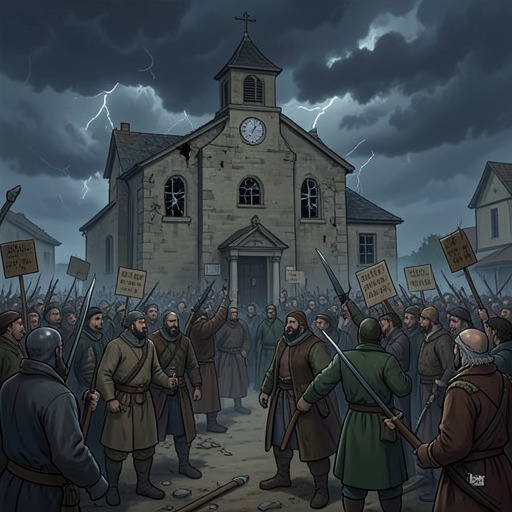
The Catholic plans entered a town already accustomed to recurring friction between the two churches. The antagonism had appeared in ethnic jokes, malicious gossip, children’s schoolyard taunts, and hostile Sunday sermons. It had also produced ugly incidents, including eggs thrown at a Parish Hall during a Baptist Youth Fellowship dance and a rock thrown through the rectory’s living-room window. Even so, much of the conflict had remained a war of words. Casino Nite gave that longstanding anger a new focus, and the hostility steadily deepened after the Daughters of Isabella announced it.
Rose’s objection was public and forceful. He had already demanded that Alan Pangborn forbid Casino Nite, first appealing to decency and then returning with a copy of Maine’s laws to argue that the event should be banned in the name of law. The Baptist campaign also used letters to the Castle Rock Call and posters bearing the slogan “DICE AND THE DEVIL.” Betsy Vigue organized the Catholic counterattack. The Call expanded to sixteen pages to accommodate the argument, but the exchange was more shouting match than considered debate; posters were torn down as quickly as they went up, and an editorial urging restraint was ignored.
Anonymous messages intensified the danger because each side could mistake a provocation for evidence of the other’s hostility. Reverend William Rose received a crude card purporting to come from loyal Catholics and threatening to stink him and his allies. Separately, Albert Gendron found a message that presented itself as a warning from concerned Baptists against Catholic worship and Casino Nite. When Father John Brigham later gathered parish supporters to discuss the atmosphere of religious repression, he recounted both his unproductive telephone conversation with Rose and Rose’s claim to have received the obscene card. The crowd’s initial shock turned to anger, and one attendee called Rose a liar. The messages did not create the underlying religious antagonism, but they gave it apparently personal and collective provocations that helped push it toward confrontation.
Collective mobilization and violence
Father John Brigham’s meeting grew beyond the rectory: so many people came that it had to be moved next door to the Knights of Columbus Hall. His description of the disputed letters and his conversation with Rose turned the gathering into a moment of parish mobilization. The response was not simply an argument about whether a fundraiser could include games of chance. Participants were now confronting what they understood as a campaign against their church and its members, while the forged or falsely attributed messages made it harder to distinguish real opposition from manipulation.
The parish’s plans for a benefit thus became entangled with Castle Rock’s broader breakdown in civic and communal order. The Baptist-Catholic dispute had grown through competing public claims, organizing, slogans, and accusations; the crude anonymous messages then made the rivalry feel immediate and threatening. The parish appears in this escalation as both a target of anti-Catholic hostility and an organized group capable of answering it. The distinction between religious advocacy and organized antagonism erodes as each side’s response supplies material for the next.
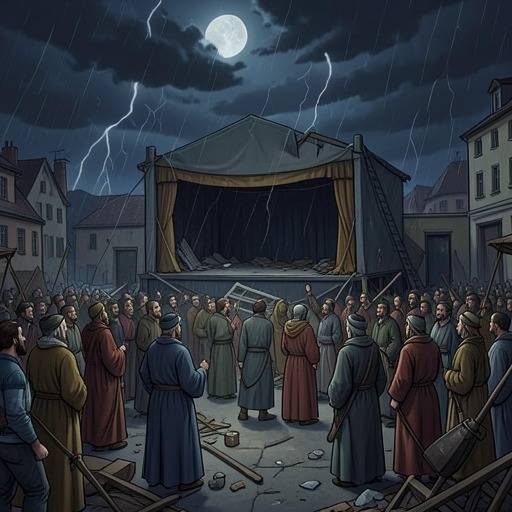
The conflict culminated in the aftermath of a stink-bomb attack at the Knights of Columbus Hall. In the rain, the Knights of Columbus, led by Father John Brigham, and the Daughters of Isabella, led by Betsy Vigue, came together in the parking lot. Vigue, crying, clung to Brigham and warned that people remained inside, naming Naomi Jessup and Tonia Bissette among them. Tonia had been killed, while Naomi staggered out in shock and asked why the attackers had done it when it was supposed to be a little fun. Brigham answered that the man was insane; beside him, Albert Gendron urged the crowd to go after the attackers. The scene converts the event’s original language of recreation into a terrible contrast: the parish gathering had been organized around a modest fundraiser, but its hall became the scene of death and a call for retaliation.
Significance
Castle Rock Catholic parish’s role in the conflict is defined by the gap between the ordinary purpose of Casino Nite and the catastrophic meanings imposed on it. The event was meant to pay for roof repairs, yet Reverend William Rose framed it as religious wrongdoing, while Father John Brigham answered years of denunciation with an attack of his own. The parish’s organizing structures—the Daughters of Isabella, the Knights of Columbus, and Brigham’s gathering—made it possible for the community to respond collectively, but collective action unfolded in an atmosphere where accusations and counterfeit messages were already turning suspicion into perceived threat.
The episode also shows how provocation works within an existing division: it does not need to invent the antagonism so much as give it a sharper object and make each group read hostile messages as confirmation of what it already fears. The parish is neither merely a passive victim nor the sole author of the conflict. It sponsors the disputed event, answers the Baptist campaign, and gathers its members when the atmosphere becomes dangerous; after the attack, grief and outrage coexist with an impulse toward revenge. The contrast between a roof-repair fundraiser and the fatal scene at the hall gives the parish’s part in the story its decisive force: a local effort to sustain a religious community is swept into a manufactured escalation whose consequences exceed the original dispute.